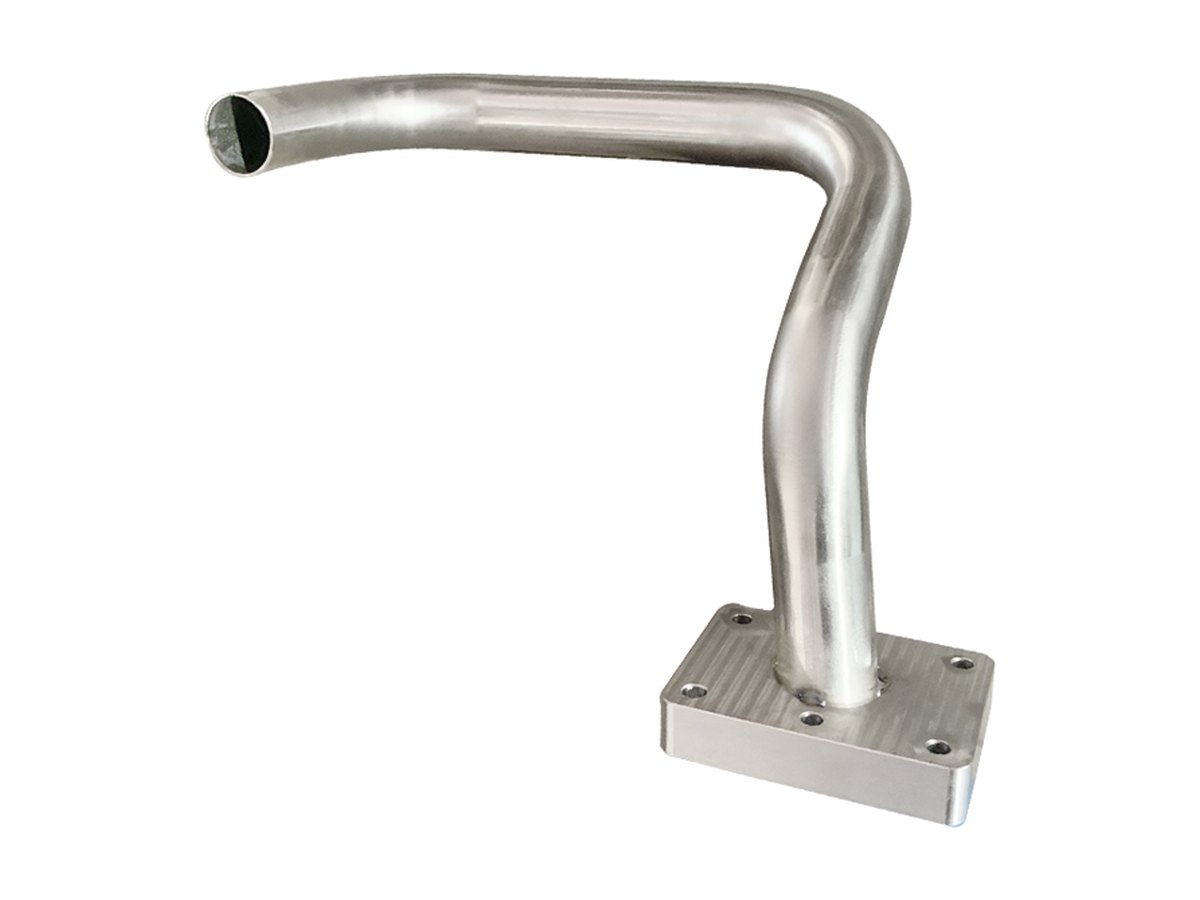
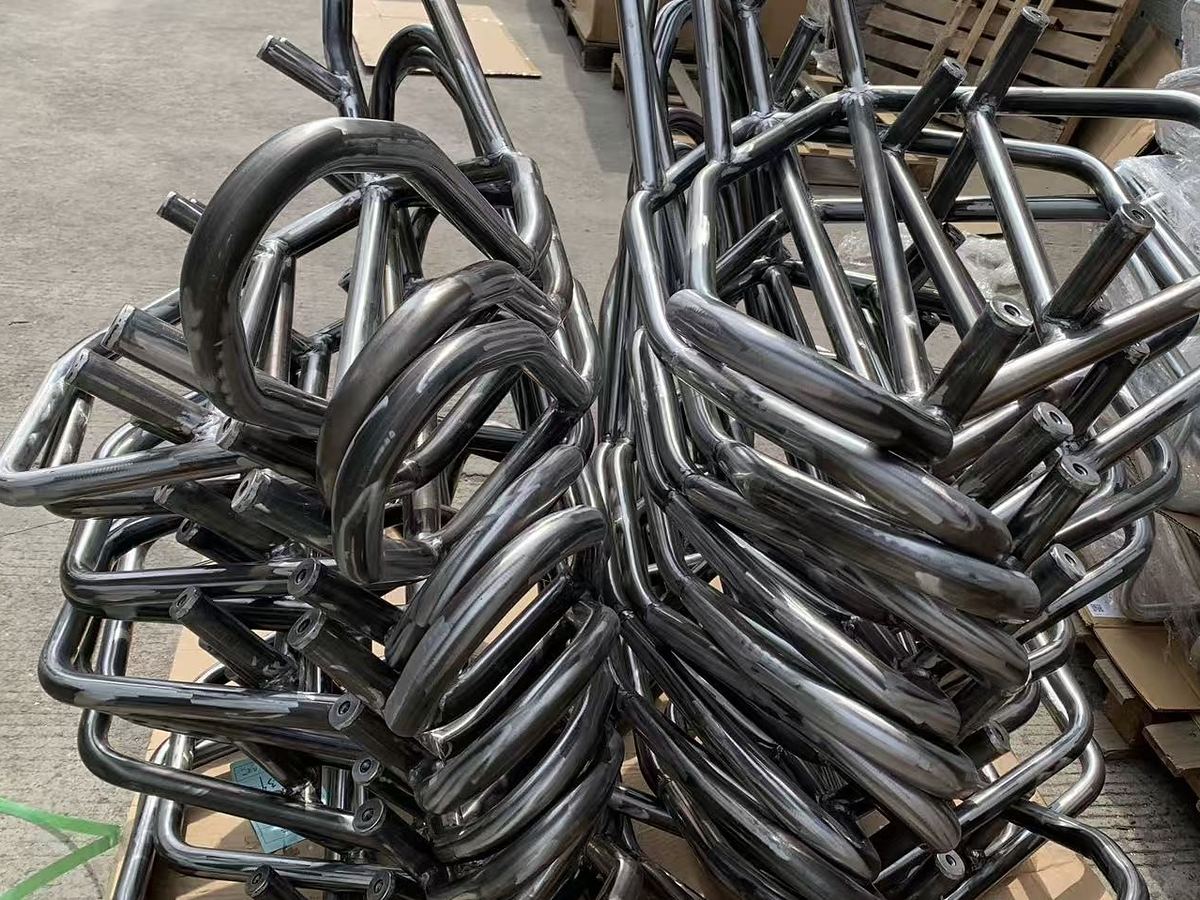
Two parts that show the rangeA stainless post with a welded base plate, and a batch of bent frames waiting for welding.
Home / Tube Parts / Handrail & Guardrail
We make the tube parts that go into handrail and guardrail systems: handrail bends, corner bends, bent posts with welded base plates, connecting pieces and mounting brackets. Round, square and oval tube from Ø4 to Ø150 mm, wall 0.8–5 mm (outside diameter from 4 to 150 millimetres), in carbon steel, 304 / 316L stainless, aluminium and copper. Every part is made to your drawing — one piece for a sample, or a short batch for a project.
A guardrail on site is a system: posts, rails, infill, fixings, anchors and a code that governs the height and the spacing. Assembling and installing that system is a different business, done by fabricators and contractors who work on site. What comes out of our workshop is the bent and welded tube that goes into it — the parts a fabricator would otherwise bend by hand.
Bending limits, tolerances and lead times are on tube bending services: Ø4–150 mm, wall 0.8–5 mm, prototype in 3 days for standard round tube with existing tooling, production 25–40 days. See inspection and document requirements before ordering.
| Tube | Outside diameter, section (round / square / oval), wall thickness, material grade |
|---|---|
| Bend | Angle, centreline radius, tangent length on each leg, and how many bends on one tube |
| Ends | Cut square, cut to angle, coped, drilled, threaded or capped |
| Attachments | Base plate, bracket, cross bar — with thickness, hole pattern and weld position |
| Finish | Brush, sandblast, powder coat, mirror polish or bare. Grinding, sandblasting and the electrolytic wash are done here; plating, coating and mirror polishing go to an outside shop. Position in the process matters: brushing happens before bending, coating after welding |
Grinding, sandblasting and an electrolytic wash are done here. Plating, powder coating and mirror polishing go to an outside finishing shop — or to yours, if you would rather keep the finishing in your own supply chain; in that case the parts ship bare. Mirror polish is only quoted after we see the part: on a bent tube the inside of the bend and the weld root cannot be reached by a polishing wheel, and we will say so before the order rather than after.
The two options are not interchangeable. A bent corner is one piece of tube with the angle formed in the die; a welded corner is two straight pieces joined at an angle. Which one belongs in your rail depends on three things: the section and diameter, the radius you have drawn, and whether the surface has to read as continuous.
Bend it when the surface should look like one unbroken run and no weld is acceptable on a visible face. A bent corner has no weld to grind back and no heat mark to blend out, so a brushed or powder-coated finish stays even across the corner. It also removes a welding operation and the straightening that follows welding.
Weld it when the geometry takes it out of bending: a radius tighter than the die can hold, a tube larger than the bender takes, a joint at an angle that is not a corner, or a T where a junction is needed rather than a change of direction. A welded corner can be any angle and any radius, because nothing has to fit a die.
The cost sits in different places, and it is not where most buyers expect it. A bend needs a die: if the radius on your drawing matches one we already hold, there is nothing to make and the part starts quickly. If it does not match, the die becomes a two-week item before any sample exists. A welded corner needs a fixture and welder time instead — fast to set up, slower per piece. On a short run of an unusual radius, welding is often the cheaper route; on a batch, the bend usually wins because the die is paid for once.
Choose 304 for indoor rails and for outdoor sites in dry, rural or ordinary urban air. Choose 316L where chlorides reach the surface — coastal and marine sites, swimming pools and pool halls, roads treated with de-icing salt, industrial atmospheres, and any specification that names 316L outright. If the installation is within a few kilometres of the sea, or the rail belongs to a pool or a waterfront walkway, 316L is the answer and the price difference is not worth reopening: the first rust bloom costs more to correct than the grade costs to buy. Where the specification already names a grade, that grade is what we quote — the drawing decides, not the catalogue.
A standard post, corner bend or connecting piece in a radius we already hold as a die takes 3 days from an approved, complete drawing, once the sample charge is settled. A radius we do not hold is a new die: two weeks to make it, then 3–5 days to run the sample. The quantity barely moves that first date — a hundred pieces of a new radius still wait for the die, and one piece of an existing radius does not. This is why the radius is the first thing worth checking before an enquiry goes further, and why sending the drawing early is worth more than negotiating the batch size.
Components are supplied as unfinished parts. Compliance with local building codes and structural requirements for the final installation is the buyer's responsibility.
The listed materials, sections, diameters and wall thicknesses are not a guarantee of every combination; feasibility is confirmed against the drawing, radius and tooling. General information only — not engineering advice. Suitability for a specific application, load case or service environment must be confirmed by the buyer's engineer.
Tube size, wall, radius and how many pieces. If the radius needs a new die, you hear that in the first reply along with the lead time.