Panyu District, Guangzhou · Manufacturing since 2013
Tube OD Ø4–150 mm hi@newsiyuantube.com
NewSiyuan TubeTube Bending · Panyu, Guangzhou WhatsApp

Home / Tube Parts / Marine

Bent 316L Tube for Boat Rails, Grab Handles and Marine Rails

We bend 316L and 304 stainless tube for boat rails and grab handles in outside diameters from 4 to 150 mm, with wall thickness from 0.8 to 5 mm. We are NewSiyuan Tube, a tube bending factory in Guangzhou, China, and samples ship in 3 days when a standard die fits your bend radius — MOQ is 1 piece for prototypes. This page covers sizes, thinning limits and the documents we provide for marine orders.

What a marine order looks like hereRails, handles, frames and the brackets that join them.

Most marine work that reaches a bending shop is not a hull — it is the fittings bolted to one. Bow rails, stern rails, grab handles, ladder frames, bimini frames, seat frames and the small mounting pads that tie them down. Those are bent tube parts welded to plates and brackets, and they are what this page is about.

Typical partsBow rail, stern rail, grab handle, ladder frame, bimini frame, seat frame, canopy hoop, cleat backing plate with a bent arm, rod holder bracket
Materials316L and 304 stainless; aluminium 6061 and 6063 for weight-sensitive frames; carbon steel where the part is fully coated
Size rangeØ4–150 mm outside diameter · wall 0.8–5 mm · round, square and oval section
What we do to itBend to drawing, laser cut and notch the ends, weld on brackets and plates, drill and tap mounting holes, dry fit the assembly
Batch size1 piece for a prototype; production runs in 25–40 days after sample approval, splittable across deliveries

One bend or two, or a weld in betweenThe decision shows up on the deck three seasons later.

A rail built from one continuous bend has no weld at the corner — the point where a rail takes a knock and where water sits. A welded corner has to be ground, polished and, on stainless, repassivated, or it becomes the first place to discolour. That is the reason to bend rather than to fabricate, and it is worth paying for a die when the geometry allows it.

Where bending winsA radius the tube can follow in a single pass, a run short enough to come off one length of stock, and a visible face where a weld line would show
Where welding winsA radius tighter than the tube will take, a run longer than stock length, a step between two diameters, or brackets and pads that have to be attached anyway
Where both appearMost real rails: the corners are bent, the straight legs and the mounting feet are welded on. That is normal, and it is what our welding stations are for
What it costs to get wrongA weld in a hand-contact area needs grinding, polishing and passivation; a bend in the wrong radius costs the die and the lead time
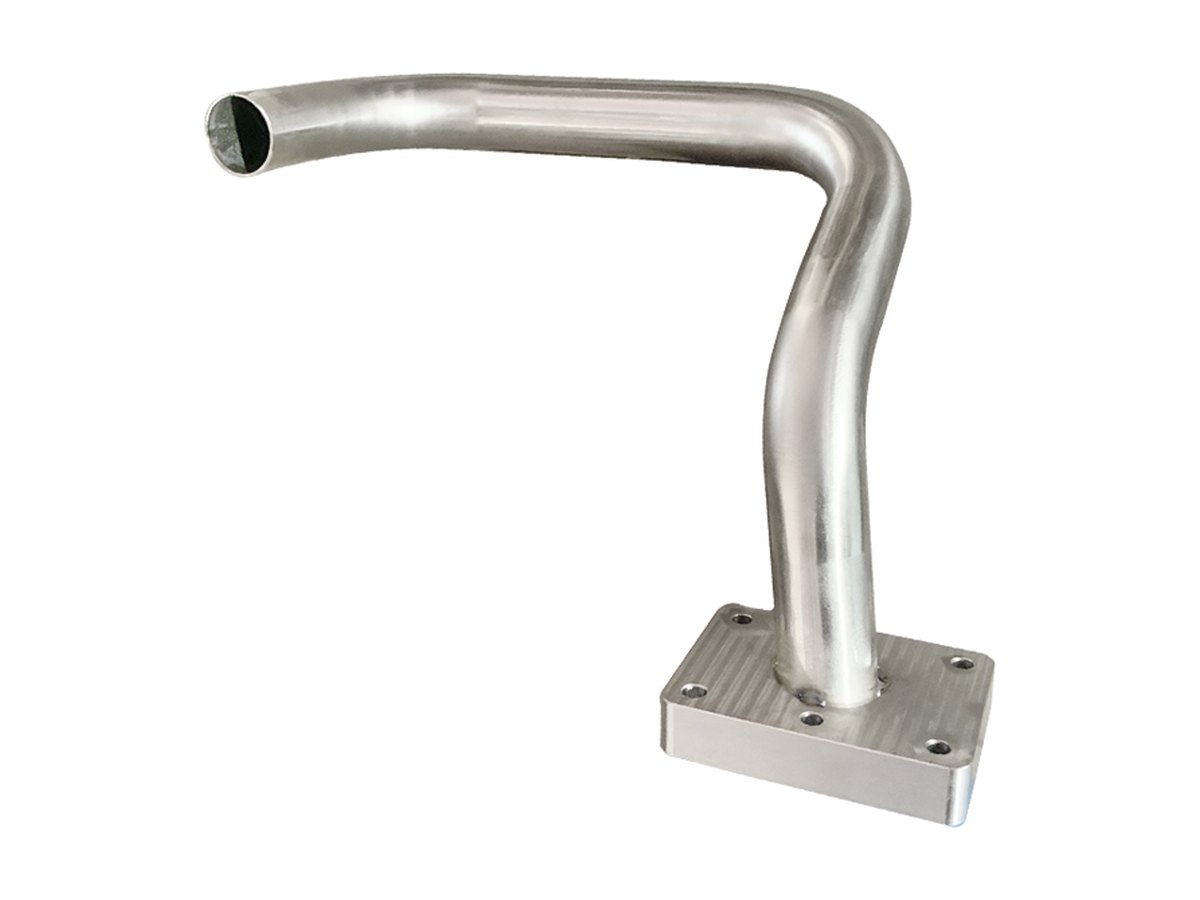
Bent stainless steel post for a rail system, radius and weld visible
A bent stainless post with the mounting arrangement welded on. The bend carries the load; the weld only locates the foot.

Wall thinning, in the place it actually happensOutside of the arc. Not inside, not the average.

Bending pulls the outer wall and compresses the inner one, so the thinnest metal ends up exactly where a rail is most likely to be struck or to carry load. We inspect against a 15% maximum on standard bends, measured on the outside of the arc against the nominal wall. On a 2 mm wall that leaves at least 1.7 mm at the bend.

What 15% works out to1.5 mm wall → 1.28 mm minimum · 2 mm wall → 1.7 mm · 3 mm wall → 2.55 mm at the outside of the bend
What makes it worseTight radius on thin wall, hard temper, no mandrel support inside the tube, and material at the low end of its own wall tolerance
What we change when it is at riskMandrel support, a larger radius, a thicker starting wall, or annealed stock — decided at the feasibility check, not discovered at inspection
What is not ours to decideHow much section a rail needs for a given load, and how much corrosion allowance to add. That is an engineering decision on your side

Material notes on this page are general guidance for discussion, not a material specification. Final selection and suitability for the intended marine environment are the buyer's engineer's responsibility.

316L or 304, and what that changes hereBoth bend. One of them survives the salt.

316L is the grade we see most often on parts that live in salt water, because the molybdenum addition holds up better against chloride pitting than 304 does. 304 is common on inland and freshwater work, and on parts that are coated anyway. Both grades run through the same tooling on this floor, so choosing between them does not change the bending cost — it changes what the part looks like after three winters.

316LDefault choice for saltwater-exposed rails, handles and frames where pitting and crevice corrosion are the concern
304Cost-effective for freshwater, inland and indoor work, and for parts that receive a coating
Aluminium6061, 6063 and 7075 for weight-sensitive frames; some tempers need annealing before bending
What matters as much as the gradeWeld quality and post-weld treatment. A 316L rail with an untreated weld can corrode at the weld sooner than a 304 rail with a clean one

General information only — not engineering advice. Suitability for a specific application, load case or service environment must be confirmed by the buyer's engineer.

Finish for a salt environmentAvailable, but specified per order rather than assumed.

Surface finishes for salt environments are available — specify the requirement at the RFQ. What we do in our own workshop is grinding, sandblasting and electrolytic cleaning, which is preparation rather than protection. Plating, powder coating, painting and mirror polishing are carried out by partner companies, and the finish sequence changes what the part measures, so the inspection point has to be agreed with it.

Done in our workshopGrinding, sandblasting, electrolytic cleaning — preparation before coating, and the visible finish on uncoated parts
Done by partner companiesPlating, powder coating, painting, mirror polishing. These are separate suppliers, not sister companies of ours
What to stateFinish type, standard, colour and whether the part is inspected before or after finishing
What we do not claimNo in-house anodising, no in-house passivation line, and no finish recommendation presented as a corrosion guarantee

Paperwork for a marine orderAgree it before the order, not at the container.

First article inspection reportProduced on your drawing for every new part number, before the batch is released. This is the document we issue ourselves
EN 10204 3.1 material certificateIssued by the material mill, not by this workshop. Availability depends on the raw-material batch and must be stated in the RFQ
Salt spray reportThird-party salt spray test reports are available on request for qualifying orders. Test duration, standard and laboratory are specified per commissioned test
Dimensional sheetBatch measurement record against the drawing, as a file
ISO 9001Not currently held — the previous certificate expired on 2025-09-08, and no renewal status is claimed here

The full list of what we can and cannot issue is on the documents page.

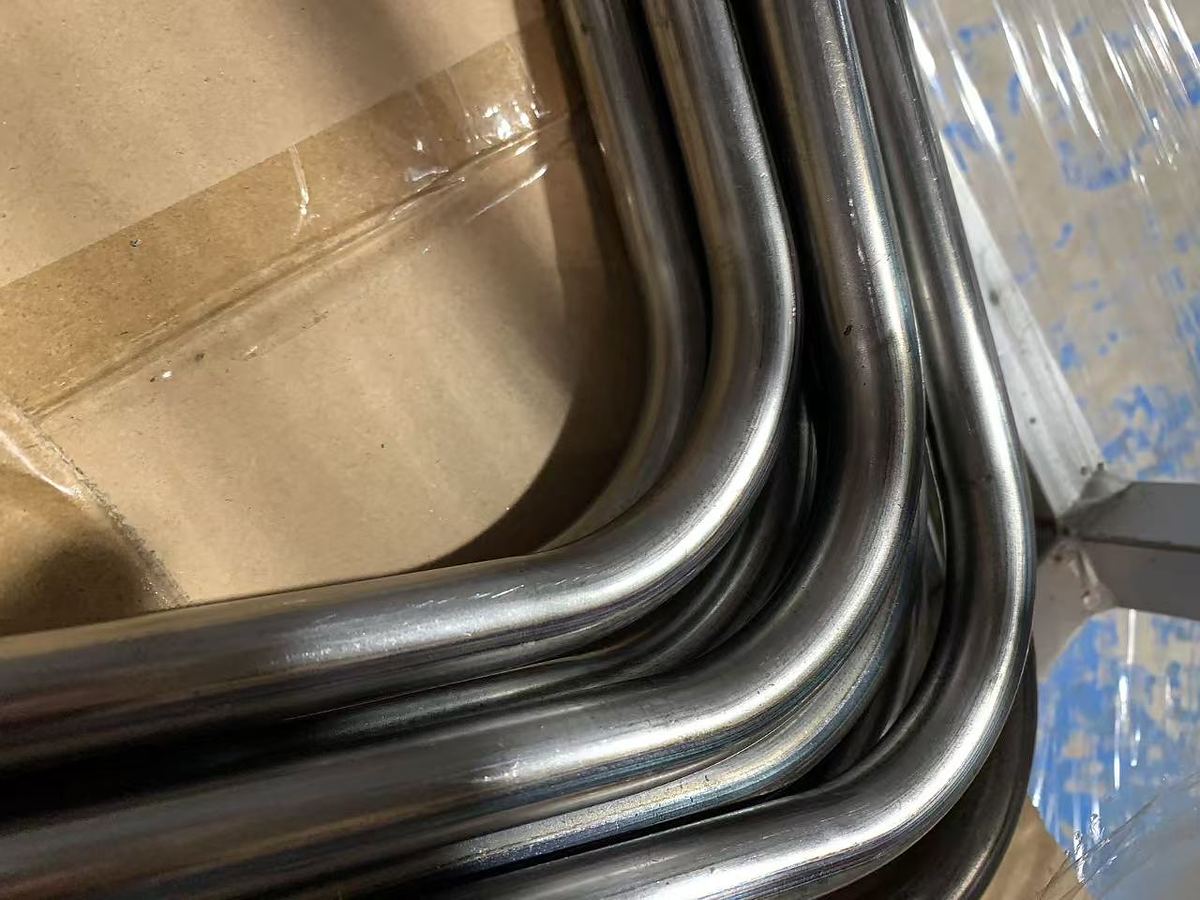
Stainless steel U-bends stacked, showing consistent bend radius across a batch
U-bends from one run, stacked on their sides. A radius that drifts across a batch shows up here before it shows up in an assembly.

Limits — not offeredA rail supplier that cannot list these is selling you something else.

  1. Not a boat builder and not a marine systems integrator. We make the bent and welded tube parts. We do not assemble rails onto a hull, and we do not design the rail layout for your deck.
  2. No installation, no site fitting. Parts ship as finished components. Fitting, alignment and sealing on the vessel are done by you or your yard — we can supply spares from the same batch if a part is damaged during fitting.
  3. No classification society approval. We do not hold approval from a class society and cannot issue a certificate in its name. Where a class requires approval of a component, that process is arranged between you and the society.
  4. No EN 1090 structural certification. Rails and frames are made to drawing and inspected dimensionally. We do not certify structural steelwork, and a marine rail is not a structural member in that sense.
  5. No in-house passivation or anodising line. Electrolytic cleaning is done here; passivation and anodising are not. If your specification names one, it is quoted as an outside process or declined.
  6. No standard corrosion warranty. Corrosion performance depends on grade, weld treatment, finish and service environment. We state what we did to the part; we do not warrant the environment.
  7. No bending above Ø150 mm. Laser tube cutting reaches Ø220 mm × 6 m, but cutting and bending are different machines — above Ø150 mm the part cannot be bent here.

General information only — not engineering advice. Suitability for a specific application, load case or service environment must be confirmed by the buyer's engineer.

Marine questions we get asked

Can you bend 316L tube for a boat rail in small quantities?
Yes. 316L bends on the same machines as 304, from 4 to 150 mm outside diameter, and the prototype MOQ is one piece. A sample takes 3 days when a die of the right radius is already on the rack; a non-standard radius adds about two weeks for the tooling.
Should a boat rail be bent as one piece or welded from segments?
A single bend removes a weld from the most visible and most loaded point of the rail, which is why it is preferred whenever the geometry allows it. Welding becomes the better answer when the radius is larger than the tube can follow, when the run is longer than the stock, or when a transition piece is needed between two diameters.
What wall thinning is acceptable on a marine bow rail?
We inspect wall thinning against a 15% maximum on standard bends, measured on the outside of the arc where the metal is stretched. On a 2 mm wall that leaves at least 1.7 mm at the thin point. Corrosion allowance and the required section for a given load are the buyer's engineer's responsibility, not ours.

Send the rail drawing and the grade you need.

The first reply says whether the radius is bendable in one pass, what the die situation is, and which documents can be confirmed for your batch.

WhatsApp