Panyu District, Guangzhou · Manufacturing since 2013
Tube OD Ø4–150 mm hi@newsiyuantube.com
NewSiyuan TubeTube Bending · Panyu, Guangzhou WhatsApp

Home / Tube Parts / Machine frames

Bent Tube Frames for Machine Guards and Industrial Equipment

Custom bent tube frames for machine guards and equipment enclosures can be laser cut, bent and welded in one factory. We are NewSiyuan Tube in Guangzhou: 2 tube laser cutters handle stock up to 220 mm diameter and 6 m length, alongside 8 bending machines covering 4–150 mm OD. Bend angle tolerance is ±1 degree, and first article inspection reports are available for every new part number. This page explains the process from drawing to batch production.

What gets built hereNot the machine — the frame around it.

Equipment makers usually need the structure rather than the machine: a guard that keeps hands away from a moving part, a frame that carries a control cabinet, a protective enclosure for a cell, a stand that levels something heavy on a factory floor. These are almost always a bent tube frame with plates and brackets welded on, and they are made to a drawing rather than chosen from a catalogue.

Machine guardsPerimeter guard frames, hinged access gates, interlock door frames, light curtain posts and mounting hoops
Equipment framesBase frames, pump and motor skids, control cabinet stands, conveyor support hoops, levelling feet with a bent arm
EnclosuresTube skeletons for panel infill, canopy hoops, roof frames, walk-in cell structures
Workholding and fixturesTrolley frames, part racks, tilt stands, jigs built from bent tube and plate
Not thisPressure vessels, load-rated lifting equipment, and anything requiring welded structural certification

Cut, bend and weld in one workshopWhich matters less for speed than for who is responsible when it does not fit.

NewSiyuan Tube runs 2 tube laser cutters handling stock up to 220 mm diameter and 6 m length — cutting only; all bending happens on 8 tube bending machines covering 4 to 150 mm outside diameter. A part that is laser cut is then bent on a bending machine, not on the laser. Welding happens here too, at 20 stations, which is what allows a frame to be checked as an assembly before it leaves the floor.

Laser tube cutting2 machines, Ø220 mm × 6 m maximum stock. Cutting only — no bending happens on these machines
Tube bending8 machines across five diameter classes, Ø4–150 mm OD, wall 0.8–5 mm
Sheet and plateLaser cut plate for brackets, gussets and mounting pads, and sheet bending for larger flat parts
Welding20 machines and stations, manual TIG and MIG. Fixtures are made in-house for repeated frames
Surface treatmentSurface treatment is handled by audited partner companies. Grinding, sandblasting and electrolytic cleaning are done here

The distinction between cutting and bending is the one that gets lost in translation most often. It is also stated on the tube bending page, because it changes what a drawing can ask for, and set out machine by machine on the laser cutting and bending page.

A frame is measured as an assemblyNot as four tubes that were each in tolerance.

Individual tubes can all pass their own inspection and still produce a frame that will not sit flat. What matters at the end is the diagonal, the face-to-face distance and whether the weld pulled the geometry. That is why a repeated frame is welded in a fixture rather than assembled by layout marks, and why the first article is checked with the frame complete.

Geometry controlWelding fixture per frame design, held for repeat orders. Fixtures are made here, so a change to the frame is a change to the fixture rather than a new supplier
What is checkedBend angles and radii on the tubes, then diagonals, face-to-face spans, hole centres and flatness on the welded frame
Typical toleranceBend angle ±1°, centreline radius ±1 mm, cut length ±0.5 mm. Frame-level squareness is agreed per drawing, because it depends on size and weld sequence
Weld distortionManaged by sequence and by fixture, not by grinding afterwards. On thin wall, the sequence matters more than the welding method
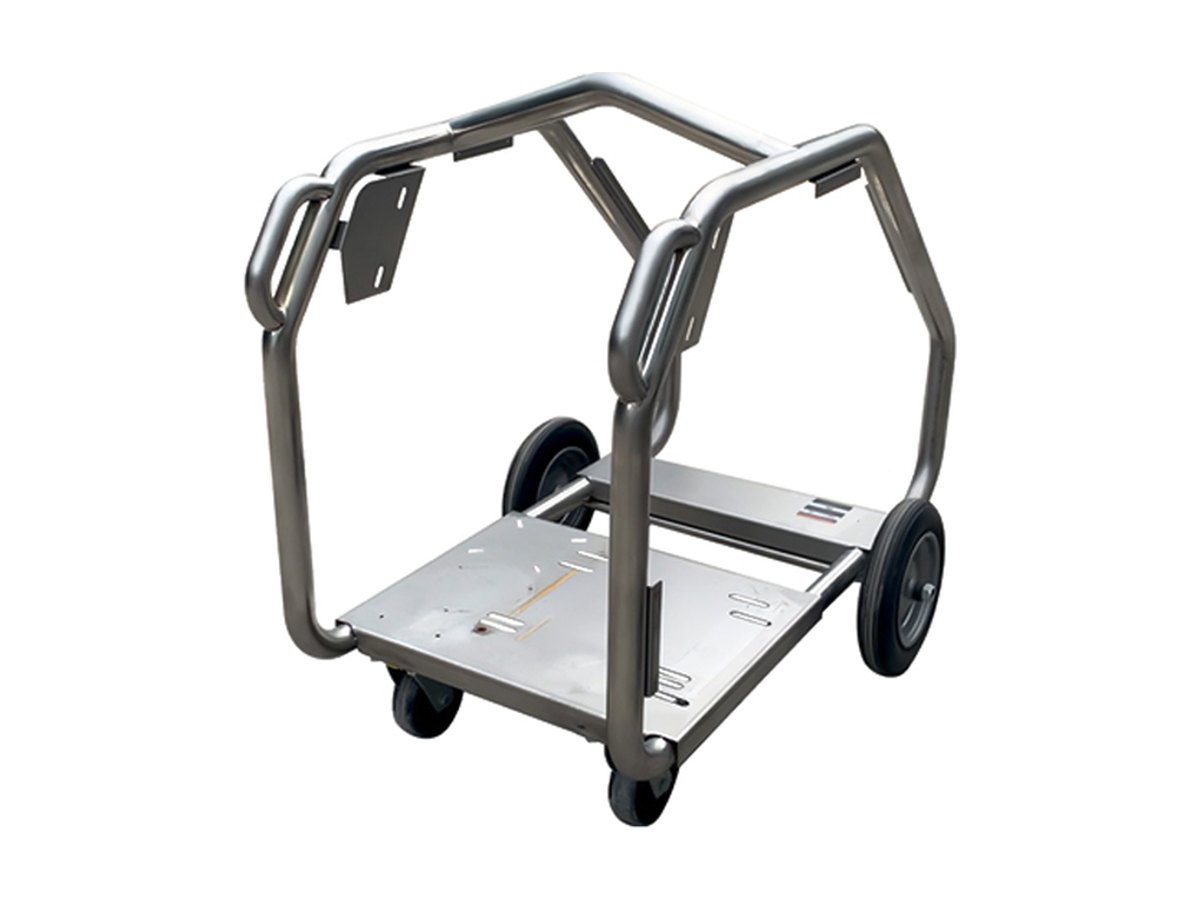
Welded stainless steel tube machine frame with brackets and cross members
A welded frame with the cross members and brackets in place. This is the point where a frame is measured, not after coating.

Material and tube choiceUsually decided by the environment, not by the load.

Most equipment frames in a dry factory are mild steel, painted, and that is the cheapest correct answer. Stainless appears where the frame is washed down, sits in a food or pharmaceutical area, or lives outdoors. Aluminium appears where the frame has to be moved by hand or carried up to a mezzanine.

Carbon steelDefault for painted frames and guards. Bent and welded, then coated by a partner company
304 stainlessWash-down areas, food handling equipment, indoor frames that must not rust at scratches
316L stainlessSalt exposure, chemical splash, and equipment on or near the coast
Aluminium 6061 / 6063Frames that get lifted, moved or shipped assembled. Some tempers need annealing before bending
SectionRound, square and oval tube. Square tube gives a flat face for panel mounting, round tube bends more predictably at tight radii

From drawing to first batchThe dates, with the condition attached to each one.

Sample3 days for standard tube with a die already on the rack; 7–10 days if material has to be brought in; about 2 weeks if a new die is needed, then 3–5 days to first article
First article reportIssued before the batch is released. On a frame this covers the tubes and the assembled geometry
Production25–40 days after sample approval, splittable if part of the order is needed earlier
What moves the dateA new die, plate thickness not in stock, and a frame design that needs a fixture built before the first weld

A frame with an unusual bend radius is worth sending as a drawing early. The radius decision sets the die, and the die sets the date — far more than the quantity does. Whether a frame should be a continuous bent section or a welded assembly is a separate decision, compared dimension by dimension on bent tube versus welded frame.

Limits — what we do not take onA frame supplier that cannot list these is a frame supplier you will argue with.

  1. No EN 1090 welded structural work. We do not hold EN 1090 certification and do not offer certified structural steelwork. Frames are made to drawing and inspected dimensionally, which is not the same thing.
  2. No load rating or lifting certification. We do not issue safe working load figures, and frames made here are not rated for lifting people or suspended loads.
  3. No pressure-retaining parts. Nothing on this page is a pressure vessel or a pressurised pipe run.
  4. No design from scratch. We machine to drawing. If the frame has to be designed, that work happens on your side and reaches us as a drawing.
  5. No surface treatment in-house beyond preparation. Plating, powder coating, painting and mirror polishing are handled by partner companies — not sister companies of ours.
  6. No bending above Ø150 mm. Laser cutting reaches Ø220 mm, bending does not. A frame that needs a larger bend cannot be made here.
  7. No certification we do not hold. No current ISO 9001 — the certificate expired on 2025-09-08 — no IATF 16949, and no CE conformity for the finished machine.

General information only — not engineering advice. Suitability for a specific application, load case or service environment must be confirmed by the buyer's engineer.

Frame questions we get asked

Can one shop laser cut and bend the tube for a machine guard?
Cutting and bending are two different machines, and both are here. NewSiyuan Tube runs 2 tube laser cutters handling stock up to 220 mm diameter and 6 m length — cutting only; all bending happens on 8 tube bending machines covering 4 to 150 mm outside diameter. A part that is laser cut is then bent on a bending machine, not on the laser.
How consistent are repeated frames across a batch?
A frame is checked as one assembly, not as separate tubes: the two loops, the brackets and the cross members are measured together against the drawing, because a frame that is square on paper only works if the diagonals match after welding. Welding fixtures, not layout marks, hold the geometry between parts.
Do you make the welded assembly or only the bent tubes?
The welded assembly. Bending, laser cutting and welding are all carried out in our own workshop, so the fixture that holds the frame during welding is made and kept here as well. Surface treatment is a separate step handled by partner companies.

Send the frame drawing and the batch size.

The first reply says whether the radii are bendable, which die situation applies, and what the first article will check on the assembled frame.

WhatsApp