Panyu District, Guangzhou · Manufacturing since 2013
Tube OD Ø4–150 mm hi@newsiyuantube.com
NewSiyuan TubeTube Bending · Panyu, Guangzhou WhatsApp

Home / Tube Bending / Bent Tube vs Welded Frame

Bent Tube vs Welded Frame: Which One, and When

There is no general answer to which is better, because the two are not competing for the same job. A bend keeps the material continuous; a weld joins what bending cannot form. We quote both from the same drawing at our workshop in Panyu, Guangzhou — bending from Ø4 to Ø150 mm and welding at 20 stations — so the choice is made on the part, not on what a supplier happens to own. This page sets out the four dimensions that decide it, and the cases where each one wins.

The four dimensions that decide itStrength, cost, sequence and weight — in that order of consequence.

Most of these arguments start with cost and end with a frame that is worse than it needed to be. The order below is deliberate: the first dimension decides whether the part survives its service life, and the last one decides what it weighs at the end of a warehouse. Cost sits in the middle because it is really a consequence of how many operations the route needs.

StrengthA bend is continuous material with a thinned outer wall and an ovalised section. A weld is full-section material interrupted by a heat affected zone and a geometric step. Static load usually favours the weld; repeated load usually favours the bend, provided the weld can be moved out of the high-stress region.
CostA bend replaces cut, cope, fit-up, weld and post-weld straightening with one machine cycle. That is five operations against one — but only once the die exists. Tooling is the whole cost argument.
SequenceA welded frame is built in stages and each stage adds distortion that has to be corrected. A bent frame is one piece that has to be right before it goes to the next operation, because a bend cannot be undone.
WeightBending lets a section follow the load path, so material goes where it is needed. A welded frame tends to be built from straight stock with generous section, because the corner has to carry what the geometry cannot.

The strength row is the one that needs an engineer. Nothing on this page is a structural calculation, and the relative merit of a bend against a weld on your frame depends on the load case, the joint position and the material.

What actually happens at a bend and at a weldTwo different ways of losing strength, and they are not comparable.

A bend does not weaken the tube in the way people expect. It redistributes material: the outside wall thins, the inside wall thickens, and the section goes slightly oval. A weld does something different — it melts, solidifies and leaves a zone beside the seam where the grain structure is not what it was. Both are manageable, and they fail differently.

At the bendOuter wall thins — held within 15% of nominal here. Section ovalises — held within 8%. The thinnest point sits on the outside of the arc and is the figure to check against your pressure or load case.
At the weldA heat affected zone beside the seam, a change of section at the toe of the weld, and residual stress that pulls the frame as it cools. Grinding the toe back improves appearance and does not restore the section.
Where each failsA bend fails by thinning through, or by ovality letting a sleeve or insert go loose. A weld fails at the toe of the seam, in the heat affected zone, usually after repeated load.
What inspection catchesA bend is caught by measuring wall thickness and diameter. A weld is caught by looking at it — which is why weld quality depends on who is holding the torch that day.
Welded tube frame assembly before painting
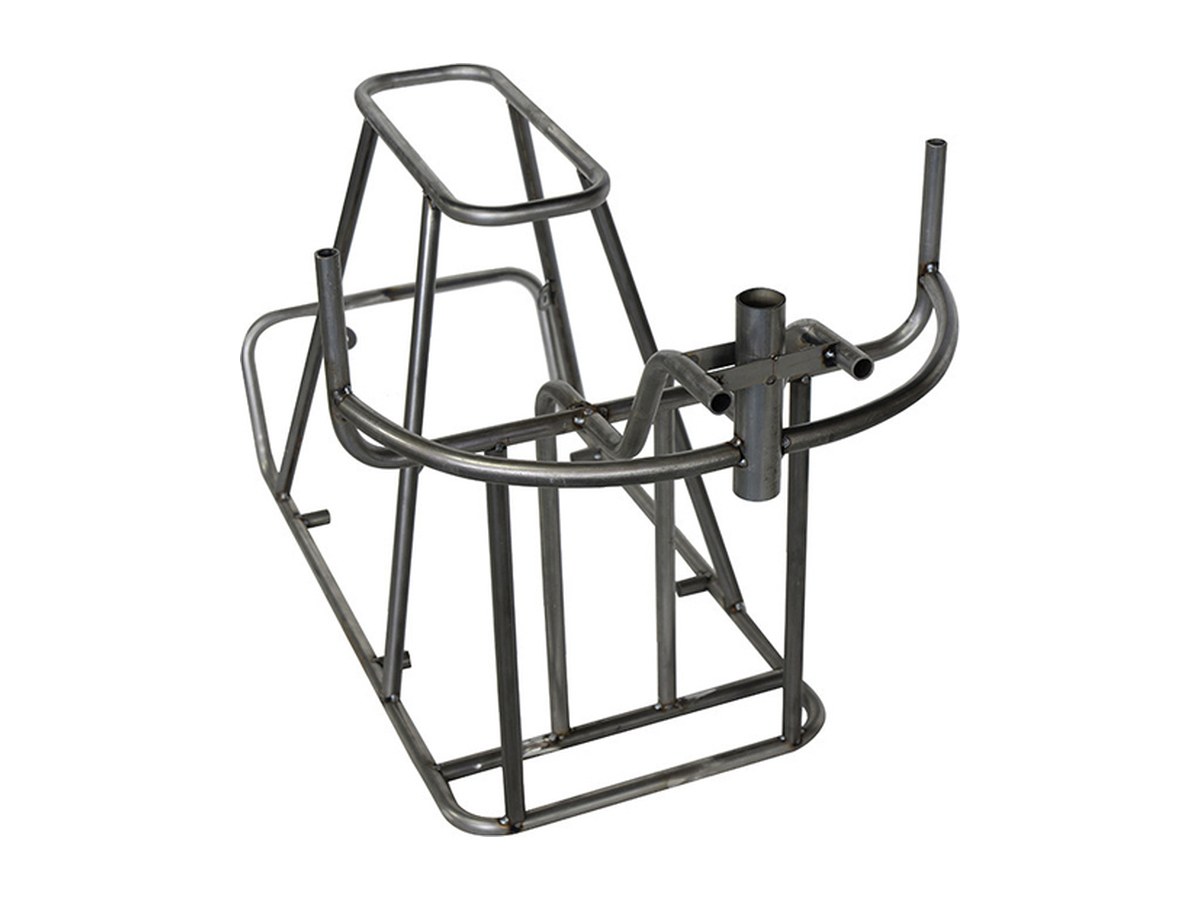
A frame before coating. The bent outer loop is one piece; the cross members are cut and welded into it. Most frames are this — both routes in the same part.

When bending winsFour situations where a weld is the wrong tool.

Bending wins wherever the shape can be formed in one continuous piece and the volume justifies the tooling. The visual argument matters as much as the mechanical one in furniture, handrail and consumer equipment, because a bend has no seam to fill, no spatter to dress and no weld line to hide under powder coat.

1. Curves, not cornersWhere the design already has a radius of several times the tube diameter, welding a corner into it adds a joint where the drawing had none.
2. Quantity above a handfulOnce the die exists, every further piece costs a machine cycle rather than five operations. The crossover is usually well below a hundred.
3. Visible surfacesA bend is a continuous surface. Under powder coat, a filled and dressed weld still shows as a change in reflection once the light hits it at a low angle.
4. Closed loops and mirrored pairsA closed loop bent from one length has no seam to align, and a mirrored pair is the same program run twice. Both are cheaper than building the shape up from segments.

There is a fifth case that is not about the frame at all: assembly time. A single bent piece arrives ready to fit. A welded assembly arrives as one unit too, but it had to be built, and the cost of that building is already inside the price.

When welding winsThree situations where bending cannot get there.

Welding is not the fallback. It is the correct route whenever the geometry asks for something a rotary bender cannot produce, and it is the only route when the frame mixes tube with plate. Pretending otherwise produces drawings with radii that no die can make.

1. Sharp cornersA bend needs a centreline radius of several times the tube diameter. A corner tighter than that collapses the wall, so the design either accepts a radius or the corner is welded.
2. Mixed material and sectionTube to plate, tube to flat bar, round to square, steel to aluminium of a different grade. A bender works on one tube at a time; a weld joins anything weldable.
3. One-offs and revisionsNo die, no tooling, no waiting. A single frame with new geometry is almost always cheaper welded, because the tooling is the entire cost.

A fourth case is more subtle: a frame that has to be flat within a tolerance across a large area. A long welded frame can be pulled straight after welding; a long bent section has whatever springback the machine left in it, and that is set once.

What this comparison does not coverRead this before using the page to make a structural decision.

  1. No structural certification. There is no EN 1090 certification behind any frame made here. We bend and weld to drawing and report dimensions; structural steelwork to that standard is outside our scope.
  2. No fatigue or load testing. No frame leaves this workshop having been fatigue tested or load tested. A deflection or a safety factor has to come from your engineer's calculation, not from this page.
  3. No safety-critical parts. Forks, brake components, steering parts and similar are not made here, in either route.
  4. No bending above Ø150 mm. Laser cutting reaches Ø220 mm and bending does not, so a large-section frame may need to be built up by welding whatever the design intended.
  5. No promised strength figure. Any statement about which route is stronger on your part depends on load case, joint position and material. It is a conversation with the drawing in front of both parties, not a rule of thumb.
  6. No post-weld treatment unless agreed. Stress relief, post-weld machining and straightening are separate operations. If a frame needs them, they have to be on the drawing and agreed before the order.

General information only — not engineering advice. Suitability for a specific application, load case or service environment must be confirmed by the buyer's engineer.

Questions we get on bent versus welded

Is a bent tube frame stronger than a welded one?
Not automatically, and the comparison is usually made in the wrong place. A bend keeps the material continuous but thins the outside wall and ovalises the section; a weld keeps the full section but introduces a heat affected zone and a geometric discontinuity where a crack can start. Which one governs depends on whether the load is static or repeated, and on whether the joint can be placed away from the highest stress.
When is bending cheaper than welding?
When the die already exists and the quantity is more than a handful. Bending removes the cut, the cope, the fit-up, the weld and the straightening after weld — five operations replaced by one machine cycle. At quantity one a new die can cost more than all of that, so the balance flips: a one-off frame with sharp corners is usually cheaper welded.
Can a bend replace a welded corner entirely?
For a radius the tooling can produce, yes, and it is usually the better answer for appearance and for weight. It cannot replace a sharp 90-degree corner with a near-zero inside radius, because every bend needs a centreline radius of several times the tube diameter to avoid collapsing the wall. Where the design needs a tight corner, that corner is welded.
Do you test the strength of a frame before shipping?
No. Parts are checked dimensionally against the drawing and reported; there is no fatigue testing or load testing behind any frame we make, and no structural certification to EN 1090. If a frame carries a load that a person's safety depends on, the structural calculation and its verification belong with your engineer, not with this workshop.

Send the frame drawing and say whether the corners can have a radius.

That single answer decides whether the part is bent, welded, or both — and it usually changes the price more than the material does.

WhatsApp